
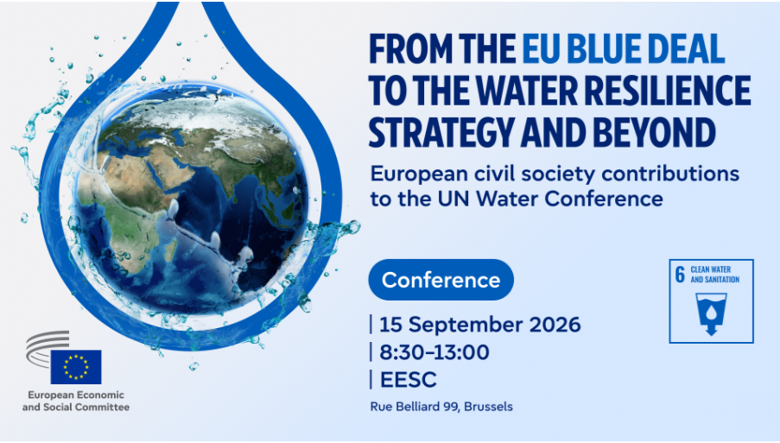
The conference “From the EU Blue Deal to the Water Resilience Strategy and Beyond – European Civil Society Contributions to the UN Water Conference,” was held by the European Economic and Social Committee (EESC) to contribute to the development of the EESC’s key recommendations for the 2026 UN Water Conference, to be held in December in Abu Dhabi.
The plenary sessions were concise and informative, complemented by six parallel sessions with representatives of civil society organisations (CSOs). Together, they provided clear and concrete insights into the key challenges and priorities for strengthening water resilience. Clear keynote presentations by the session panellists were followed by in-depth discussions and a valuable exchange of views among all participants. As a result, the final recommendations are practical, well-grounded in the discussions, and responsive to the real challenges identified throughout the sessions.
It was particularly important that Ukraine was not overlooked in discussions on resilience. The water supply challenges we have been facing for the past almost five years and managing to withstand demonstrate how fragile the resilience of water supply systems can be if their operation under emergency conditions and during military conflicts is not considered.
Our experience shows that the resilience of water supply systems is closely linked to energy resilience and should therefore be considered in conjunction with the development of renewables and energy efficiency, which is another of the EU's key policy priorities.
I found the discussions in the “Investments for Water” and “Water in Materialism” panels particularly relevant for my experience and expertise. And although public-private partnership (PPP) was not explicitly included in the programme, PPP issues naturally emerged during the discussions, highlighting their relevance to the challenges under consideration.
Everyone agreed that closing the water investment gap and achieving SDG 6 will require the mobilization of public, private, and additional sources of finance. However, attracting private capital, particularly in countries where the need for clean water and sanitation infrastructure is most urgent, requires stronger governance and institutional capacity, as well as effective mechanisms to de-risk investments in water infrastructure.
The solution lies in developing, piloting, and scaling flexible financing models based on mixed and blended finance, while promoting them and clearly communicating their benefits to governments, businesses, and civil society. Such an approach can help reconcile two seemingly conflicting objectives: (1) making water projects bankable and sufficiently attractive to investors by managing and mitigating risks, and (2) preserving their social purpose and ensuring alignment with the Sustainable Development Goals. PPP can provide an effective framework for bringing these elements together and mobilising the investment needed to strengthen water resilience.
One aspect that seemed somewhat underrepresented in these discussions was the business perspective. The views of civil society organizations, employers’ organizations, trade unions, and research institutions are extremely important, but businesses should not remain on the sidelines. Their experience, investment capacity, and practical understanding of project development and risk are essential to turning water resilience ambitions into viable and sustainable investments